

Millions of people want exposure to OpenAI before it goes public — but most assume they either need accredited status, six figures, or a seat at the VC table. They don't. OpenAI filed its S-1 on June 8, 2026, and the IPO could still be months away. Here's every way to take a position today — from secondary shares to public proxies to private markets derivatives exchanges — plus what the company is actually worth and what risks to watch.
Key Takeaways
How much is OpenAI worth right now?
OpenAI is valued at $852 billion following its record-breaking $122 billion Series F round in March 2026 (CNBC). CEO Sam Altman has reportedly said he would treat any IPO valuation below $1 trillion as a non-starter.
When is the OpenAI IPO?
OpenAI filed a confidential S-1 with the SEC on June 8, 2026. Goldman Sachs, Morgan Stanley, and JPMorgan are leading the deal. The company initially targeted Q4 2026, but the New York Times reported in late June that OpenAI is leaning toward delaying until 2027. No date is confirmed.
Can you get exposure to OpenAI before the IPO?
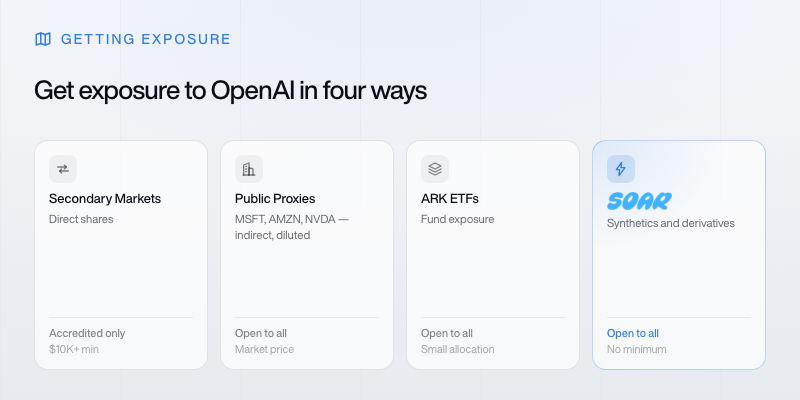
Yes. Options include secondary marketplaces (accredited investors only, $10,000+ minimums), public companies with OpenAI exposure (Microsoft holds a major stake), ARK Invest ETFs that now include OpenAI, and private markets derivatives exchanges like SOAR where participants can take a position on OpenAI's valuation and IPO outcomes without accreditation requirements.
How Much Is OpenAI Worth in 2026?
OpenAI is valued at $852 billion following its $122 billion Series F round in March 2026 — the largest private funding round in Silicon Valley history (CNBC). The company's valuation has grown nearly 3x in under a year.
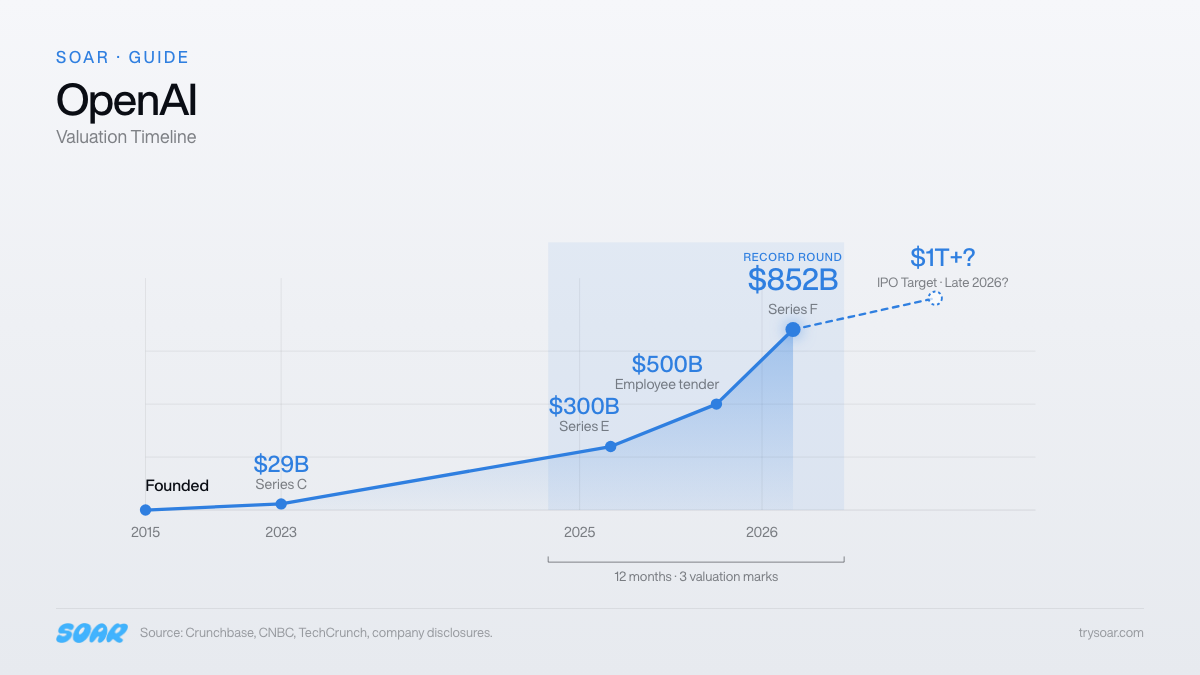
The round was co-led by Amazon ($50 billion), Nvidia ($30 billion), and SoftBank ($30 billion), with participation from a16z, Thrive Capital, Sequoia, Fidelity, BlackRock, and ARK Invest (Tracxn). OpenAI also opened participation through bank channels for the first time, raising $3 billion from individual investors.
Total funding stands at approximately $180 billion across 14 rounds — a sum that exceeds the total annual U.S. venture capital investment during any year before 2021 (Tracxn).
How does OpenAI's valuation compare to Anthropic's? Anthropic surpassed OpenAI in private market valuation in May 2026 ($965B vs $852B). The gap is driven by revenue: Anthropic's $47 billion ARR is nearly double OpenAI's $25 billion, and Anthropic's enterprise market share edged ahead at 34.4% vs OpenAI's 29–32% (Counterpoint Research). OpenAI counters with consumer dominance: 900 million weekly users, 50 million subscribers, and the most widely recognised AI brand on earth.
How Is OpenAI Making Money?
OpenAI generates approximately $2 billion per month in revenue as of mid-2026, putting annualized run-rate revenue at roughly $25 billion (TechCrunch). That's up from $6 billion in 2024 and $2 billion in 2023 — a growth rate no software company has matched (Epoch AI).
Revenue breaks down into three streams:
- ChatGPT subscriptions (~70%): Roughly $1.4 billion per month across 50 million paid subscribers. ChatGPT crossed 900 million weekly active users and 1 billion monthly active users in early 2026.
- API revenue (~25%): Approximately $500 million per month. The API processes over 15 billion tokens per minute, powering enterprise applications, developer tools, and third-party integrations.
- Sora and licensing (~5%): Roughly $100 million per month from video generation, content licensing deals, and other emerging products.
Enterprise now represents more than 40% of revenue and is on track to reach parity with consumer by end of 2026, according to OpenAI's own disclosures. The company counts 9 million business users.
The key difference from Anthropic: OpenAI's revenue is consumer-heavy, driven by one flagship product. Anthropic is 80% enterprise. Both approaches scale differently and carry different risk profiles.
When Is the OpenAI IPO?
OpenAI filed a confidential S-1 with the SEC on June 8, 2026, formally beginning the IPO process. Goldman Sachs, Morgan Stanley, and JPMorgan are leading the offering, with a target valuation between $852 billion and $1 trillion.
However, the timeline is less certain than Anthropic's. OpenAI initially targeted Q4 2026, possibly as early as September. But the New York Times reported on June 25 that the company is leaning toward waiting until 2027, and as of late June OpenAI had held no pre-IPO investor meetings (CNBC).
Several factors are driving the potential delay. The public S-1 would need to disclose the full Microsoft revenue-share restructuring (renegotiated April 2026), the OpenAI Foundation's governance rights under the new for-profit structure, the Stargate infrastructure capex schedule, and a profitability timeline. Each of these is complex, and OpenAI may want more time to strengthen the numbers.
Analyst consensus (FutureSearch) puts the median IPO date around mid-2027, with roughly a one-in-seven chance of a 2026 listing.
What cleared the legal path for OpenAI's IPO? On May 20, 2026, a jury dismissed Elon Musk's lawsuit against OpenAI — removing what analysts had called the biggest legal obstacle to going public. The filing came two days later. The April 2026 Microsoft partnership restructuring also cleaned up the corporate structure, converting OpenAI from a capped-profit model to a standard for-profit entity.
How Can You Get Exposure to OpenAI Before the IPO?
There are four main routes to get exposure to OpenAI before the listing: secondary marketplaces, public company proxies, ETFs, and private markets derivatives exchanges.
Secondary Marketplaces (Accredited Investors Only)
Platforms like Hiive, Forge Global, and EquityZen allow accredited investors to buy OpenAI shares from existing shareholders. These require accredited status and minimums typically starting at $10,000–$50,000. Secondary pricing currently implies valuations between $700 billion and $852 billion depending on platform and timing.
Public Company Proxies
The tradeoff remains the same: you get a diversified company that owns a piece of OpenAI, not a direct position on OpenAI's valuation or IPO outcome.
ARK Invest ETFs
OpenAI announced in March 2026 that it would be included in several exchange-traded funds managed by ARK Invest — making this the first time retail investors could access OpenAI exposure through a standard brokerage account. The allocation is small relative to the total fund, but it represents a meaningful new access point.
Private Markets Derivatives Exchanges
SOAR is a private markets derivatives exchange built for companies that aren't yet public. It uses implied pricing to let participants trade on company-specific outcomes including valuation, IPO timing, and funding milestones. Unlike secondary marketplaces, SOAR doesn't require accredited investor status or five-figure minimums.
For broader context, see How to Value a Startup and Best Pre-IPO Stocks to Watch in 2026.
What Are the Risks?
OpenAI's financials carry a fundamentally different risk profile than Anthropic's.
Cash burn. OpenAI loses approximately $1.22 for every $1 of revenue (RoboRhythms). Projected losses are roughly $14 billion non-GAAP in 2026, but GAAP losses including stock-based compensation could reach $27–33 billion (FutureSearch). Cumulative cash burn through 2029 is forecast at approximately $115 billion.
Revenue concentration. Roughly 70% of revenue comes from one product — ChatGPT subscriptions. If consumer willingness to pay $20/month for AI declines, or a competitor matches ChatGPT's functionality, revenue is exposed.
Anthropic competition. Anthropic surpassed OpenAI in enterprise AI market share (34.4% vs 29–32%) and private market valuation ($965B vs $852B) in 2026 (Counterpoint Research). The enterprise segment is OpenAI's growth vector, but Anthropic has a meaningful head start there.
Governance complexity. OpenAI's transition from a capped-profit structure to a for-profit entity introduced new governance layers, including the OpenAI Foundation's retained rights. How these work in practice as a public company is untested.
IPO timing uncertainty. Unlike Anthropic's firm October target, OpenAI may delay to 2027. A longer wait means more cash burn, more competitive pressure, and a higher bar for the numbers in the public S-1.
Frequently Asked Questions
Is OpenAI publicly traded?
No. As of July 2026, OpenAI is private. It filed a confidential S-1 on June 8, 2026, but no listing date is confirmed. The company may go public in late 2026 or 2027.
How much revenue does OpenAI generate?
OpenAI generates approximately $2 billion per month, or roughly $25 billion annualised. About 70% comes from ChatGPT subscriptions, 25% from the API, and 5% from Sora and licensing.
Who are OpenAI's biggest investors?
Amazon ($50B), SoftBank ($30B+), Nvidia ($30B), Microsoft ($13B+), a16z, Thrive Capital, Sequoia, and Fidelity. Total funding is approximately $180 billion across 14 rounds.
Can I get exposure without being an accredited investor?
Yes. ARK Invest ETFs now include OpenAI exposure, available through any standard brokerage. Private markets derivatives exchanges like SOAR allow non-accredited participants to take positions on OpenAI's valuation and IPO outcomes. Microsoft (MSFT) stock provides indirect but diluted exposure.
How does OpenAI compare to Anthropic as an investment?
OpenAI has broader consumer reach (900M weekly users, 50M subscribers) and higher brand recognition. Anthropic has nearly 2x the revenue ($47B vs $25B ARR), higher enterprise market share, and a firmer IPO timeline (October 2026 vs uncertain). OpenAI burns significantly more cash. Both are valued near $1 trillion. The choice depends on whether you think the consumer platform or the enterprise infrastructure play wins long-term.
Ready to take a position on OpenAI? Explore OpenAI on SOAR →
This article is for informational purposes only and does not constitute financial advice. Trading on prediction market platforms involves risk, and past performance does not guarantee future results. Always conduct your own research before making any financial decisions.