

Valuing a startup is one of the most contested conversations in private markets. Two investors can look at the same company, the same metrics, and the same market — and arrive at valuations that differ by millions. It’s how private company valuation works: part framework, part negotiation, part timing.
This article breaks down the numerical methods investors actually use, the multiples that are moving in 2026, and the specific inputs that separate a 3× company from a 10× one.
Key takeaways
How do you value a startup?
Most startups are valued using an ARR multiple — annual recurring revenue multiplied by a market-determined factor, adjusted for growth rate, net revenue retention, gross margin, and profitability. Pre-revenue startups use qualitative methods like the Berkus method, assessing founders or comparable transaction analysis.
What is a normal valuation multiple for a startup in 2026?
Private B2B SaaS companies trade at a median of 4.8× ARR (bootstrapped) and 5.3× (equity-backed), per SaaS Capital’s 2025 survey. Public SaaS sits at 3.4× EV/Revenue as of March 2026, per Aventis Advisors — down from an 18–19× peak in 2021.
What is the single biggest driver of startup valuation?
Growth rate — it carries roughly 2× the valuation impact of equivalent profitability improvement, per Bessemer. In 2026 the Rule of 40 (growth rate + profit margin ≥ 40) has become the primary composite benchmark, penalizing growth without capital efficiency.
Why do different investors value the same startup differently?
Because valuation is a negotiation, not a formula. A growth-stage VC optimizing for 10× returns and a strategic acquirer buying for product fit will arrive at different numbers for the same business — different exit horizons, discount rates, and market assumptions.
The two types of startup valuation
Startup valuation depends almost entirely on stage — specifically, whether the company has material recurring revenue or not. Before revenue, valuation is largely qualitative. After revenue, it becomes quantitative and market-driven.
Pre-revenue (seed and early Series A): No ARR to anchor the valuation, so investors use methods that value the opportunity, the founders and team, and the traction signals available. Valuation at this stage is more negotiation than science — founders and investors align on a number that reflects the capital needed, the equity being offered, and the market opportunity.
Revenue-stage (Series A and beyond): Once a company has meaningful ARR — typically $1M+ — valuation shifts to a multiple-based framework. The multiple is set by comparable public companies and private transactions, then adjusted for the specific company’s profile. This is where most of the analytical work happens.
Why do early-stage valuations vary so much? Because there’s no revenue to anchor the discussion. Two seed-stage companies in the same market can price very differently based on founder reputation, competitive dynamics, investor demand, and the terms being negotiated. Pre-revenue valuation is as much a function of fundraising process as it is of fundamentals.
Pre-revenue valuation methods
For startups without material ARR, four methods dominate:
The Berkus method. Developed by angel investor Dave Berkus, this approach assigns a dollar value to five risk dimensions: soundness of the idea, prototype existence, quality of the founders management team, strategic relationships, and product rollout or sales. Each dimension can contribute up to $500,000 to a maximum pre-money valuation of $2.5 million. The method is deliberately simple — it forces investors to articulate which risk factors they’re underwriting rather than reverse-engineering a DCF.
The scorecard method. Compares the startup to a median pre-revenue deal in the region and sector, then adjusts up or down based on weighted factors: management team (30%), market opportunity (25%), product/technology (15%), competitive environment (10%), marketing and sales channels (10%), and other (10%).
Comparable transactions. Seed-stage SaaS companies in 2025 raised at median pre-money valuations of approximately $10–12 million, per Carta’s Q4 2025 data. Series A medians sat at $35–45 million pre-money.
The venture capital method. Works backward from an expected exit. If an investor expects to sell in 5 years at a $100 million valuation and needs a 10× return, the method calculates the required ownership percentage and works backward to the current valuation. Common as a sanity check.
Revenue-stage valuation — ARR multiples
Once a company has meaningful recurring revenue, the dominant valuation framework is the ARR multiple: enterprise value equals ARR multiplied by a market-determined factor.
Valuation = ARR × Multiple
As of Q1 2026, per the most recent market data:
- Public SaaS median: 3.4× EV/Revenue, per Aventis Advisors
- Private SaaS median: 4.8× ARR (bootstrapped) and 5.3× ARR (equity-backed), per SaaS Capital 2025 survey
- Top quartile private: 8.1× ARR, per Aventis Advisors database of 543 disclosed deals
- High-performing outliers: 7–12× ARR for companies with Rule of 40 above 50 and NRR above 120%, per The VC Corner
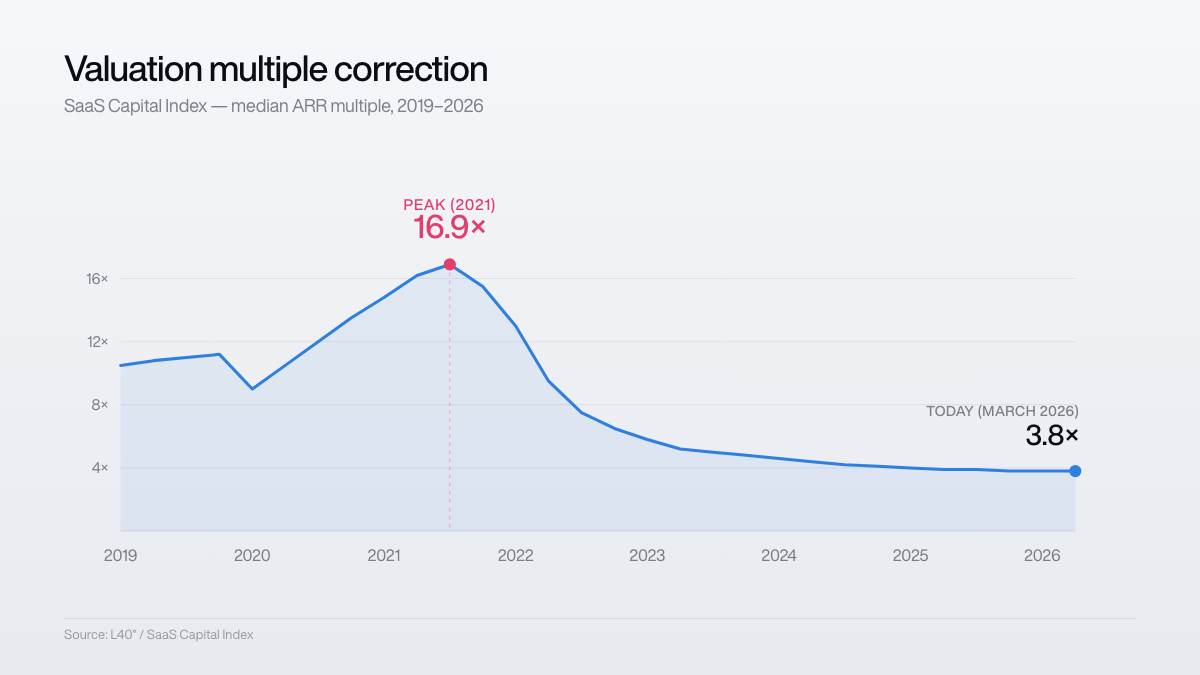
The SaaS Capital Index — which peaked at 16.9× ARR in 2021 — stood at 3.8× as of March 2026, per L40°, reflecting the structural correction driven by AI disruption pressure and rising cost of capital. Private multiples lag public movements by 6–12 months, meaning private deals are pricing into expectations that public markets have already corrected for.
Is the ARR multiple the same for all startup types? No. The ARR multiple framework applies most cleanly to subscription SaaS businesses. Marketplaces, hardware, services businesses, and pre-SaaS software companies use different frameworks: gross merchandise volume multiples, revenue multiples without the ARR qualifier, or EBITDA multiples for businesses with positive earnings.
What moves the multiple up or down
The median multiple is the starting point. These factors determine where in the range a specific company lands:
Growth rate — the dominant factor. Per Bessemer’s valuation data, growth rate has roughly twice the valuation impact of equivalent profitability improvement. Companies growing ARR at 40%+ year-over-year command materially higher multiples than those growing at 20%, all else equal. Sub-20% growth at any stage compresses toward 2–4×.
Net revenue retention (NRR). NRR measures how much ARR the company retains and expands from existing customers year-over-year. A company with 120% NRR generates 20% more ARR from existing customers without any new customer acquisition. Per FE International’s analysis, a 10-point improvement in NRR translates to a 20–30% valuation uplift.
Gross margin. SaaS businesses with 70–85% gross margins trade at premium multiples because most of each revenue dollar flows through to the bottom line. Infrastructure-heavy businesses or services-embedded software trade at discounts.
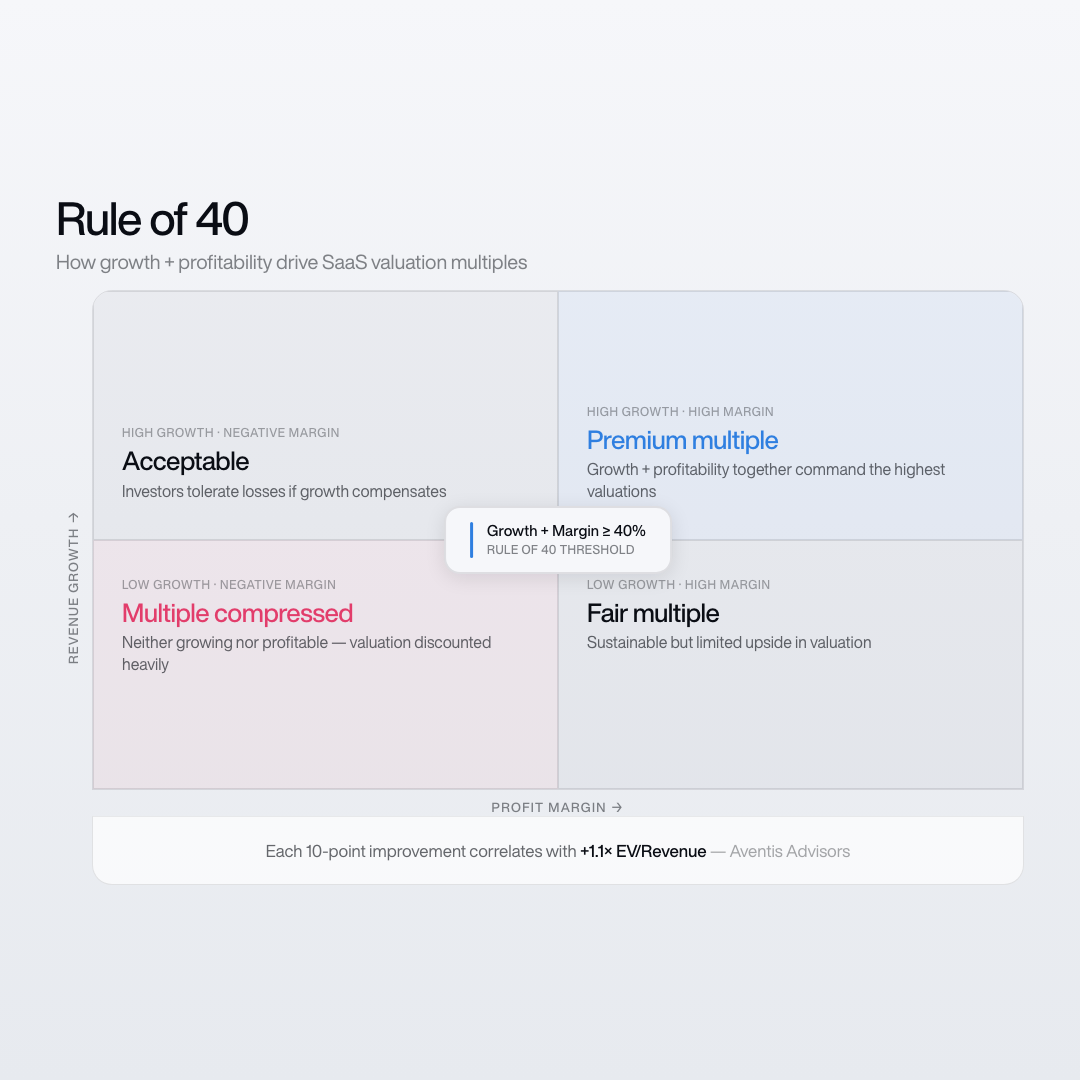
Rule of 40. The sum of a company’s ARR growth rate and EBITDA margin should exceed 40%. McKinsey’s analysis found that companies exceeding this benchmark generate 15% higher shareholder returns over time. Per Aventis Advisors, each 10-point improvement correlates with approximately +1.1× EV/Revenue.
Scale. Companies transacting at $50–100M ARR consistently achieve multiples nearly twice those of companies at $20–50M ARR, per Aventis Advisors’ database of 543 disclosed private M&A transactions.
AI defensibility. In 2026, 72% of SaaS M&A targets referenced AI in their positioning, per Software Equity Group. Buyers are scrutinizing AI claims rigorously — distinguishing between measurable AI impact and marketing-driven positioning. Genuine AI integration commands a premium; AI as a feature checkbox does not.
The Rule of 40 and why it matters in 2026
The Rule of 40 has emerged as the primary composite benchmark for SaaS valuation — a single number that balances growth and profitability in a way that pure ARR multiples don’t.
The formula: ARR growth rate + EBITDA margin ≥ 40%.
A company growing at 50% with −10% EBITDA margin scores 40. A company growing at 25% with 15% EBITDA margin also scores 40. Both are healthy by the benchmark. A company growing at 15% with −10% EBITDA margin scores 5 — and will struggle to attract premium multiples regardless of absolute ARR.
The Rule of 40 matters in 2026 because the market has shifted from rewarding growth alone to rewarding the combination of growth and capital efficiency. In 2020–2021, burn multiples above 3× were tolerated. Then interest rates rose, and the correction was swift. Bessemer’s data now shows a 2:1 weighting in favor of growth over profitability within the Rule of 40 framework — but only above a minimum efficiency floor.
The median Rule of 40 score across public SaaS companies as of Q4 2025 was just 28%, per SaaS Capital efficiency benchmarks. Only 20% of publicly traded SaaS companies exceed the 40% threshold.
Valuation vs price — why they’re not the same
Valuation is what a model says a company is worth. Price is what a buyer actually pays. They are frequently different.
An investor’s valuation model might output $50 million post-money for a Series A. But if three competing term sheets arrive at $65 million, the price is $65 million regardless of the model. Competitive process and investor demand move price independently of analytical valuation frameworks. The reverse is also true: objectively strong metrics might price below model valuation if there’s no competitive process or if the market is risk-off.
In private markets, valuation is also point-in-time — it reflects what two parties agreed to on a specific date. Anthropic was officially valued at $380 billion in February 2026 and $965 billion three months later. In between, the official mark was $380 billion — regardless of what the information environment suggested.
This is the fundamental limitation of traditional startup valuation: it is intermittent by design, set only when a company chooses to raise, and reflects negotiated point-in-time agreement rather than continuous market consensus.
How SOAR produces a continuous implied valuation
Traditional startup valuation is a snapshot. SOAR produces a continuous, crowd-sourced alternative.
SOAR runs prediction market contracts on specific private company valuation outcomes — will Anthropic’s next round price above $1 trillion? Will SpaceX IPO before 2027? Each contract has a price set by collective trader conviction, updated in real time as new information reaches the market. Read together, a set of contracts at different valuation thresholds implies a full probability distribution over a company’s valuation — what the market thinks the company is worth right now, not what two parties agreed to at the last funding round.
In May 2026, Polymarket’s implied valuation for Anthropic was $1.0765 trillion two days before its Series H printed at $965 billion — capturing 84% of the true repricing before the official announcement, per SOAR’s Public Price Discovery research paper.
For anyone who wants a real-time, market-derived view of what a private company is worth — not a stale ARR multiple applied to a six-month-old funding round — implied pricing via prediction markets is the only mechanism that currently exists.
Frequently asked questions
How do you value a startup with no revenue?
Pre-revenue startups are typically valued using qualitative methods: the Berkus method, the scorecard method, or comparable transaction analysis. Carta’s Q4 2025 data shows median pre-money valuations of $10–12 million at seed and $35–45 million at Series A for SaaS companies. At this stage, team quality, market size, and investor demand do more to set the price than any formula.
What is a good ARR multiple for a private SaaS company?
In 2026, a median private SaaS company trades at 4.8–5.3× ARR depending on funding status, per SaaS Capital’s 2025 survey. A multiple above 7× indicates strong growth (40%+ ARR growth), high NRR (110%+), or a competitive fundraising process. A multiple below 3× typically reflects sub-20% growth, elevated churn, or margin deterioration. The range runs from 2× for slow-growth companies to 12× for elite performers in a competitive process.
Why do VCs value the same startup differently?
Because valuation reflects an investor’s specific return thesis, not just the company’s fundamentals. A growth-stage VC who needs a 10× return in 5 years and a strategic acquirer buying for product integration will arrive at different numbers for the same business — different exit timelines, different discount rates, different views on market opportunity size.
What is the Rule of 40 and how does it affect valuation?
The Rule of 40 states that a software company’s ARR growth rate plus its EBITDA margin should equal or exceed 40%. Per McKinsey, companies exceeding the Rule of 40 generate 15% higher shareholder returns over time. Per Aventis Advisors, each 10-point improvement in Rule of 40 score correlates with approximately +1.1× EV/Revenue multiple.
This article is for informational and educational purposes only and does not constitute investment, legal, or financial advice. Trading event contracts and investing in startups involves risk and may not be suitable for everyone. You could lose the funds used to enter any transaction.try