

Prediction markets are financial exchanges where the price of a contract is the forecast. Traders buy and sell positions on whether specific future events will happen — and the collective price of those positions tells you what the market thinks the probability is, in real time.
In 2024 alone, over $8 billion moved through prediction markets globally, driven by elections, economic decisions, and the growing appetite for markets that move on real information rather than opinion. This article covers how they work, why they outperform traditional forecasting, and where the category is heading next — including the private company markets that existing platforms don't yet cover.
Key takeaways
What is a prediction market in simple terms?
A prediction market is a contract-based exchange where traders buy and sell positions on the probability of a specific future outcome. The price of a contract reflects the market’s collective estimate of the likelihood that outcome will occur — a contract trading at 72 cents implies a 72% probability of that outcome resolving true.
How do prediction markets set their prices?
Prices are set by the market — buyers and sellers trading against each other based on their beliefs about probability. When new information emerges, traders update their positions, moving the price to reflect the updated consensus. No single entity sets the odds.
Are prediction markets accurate?
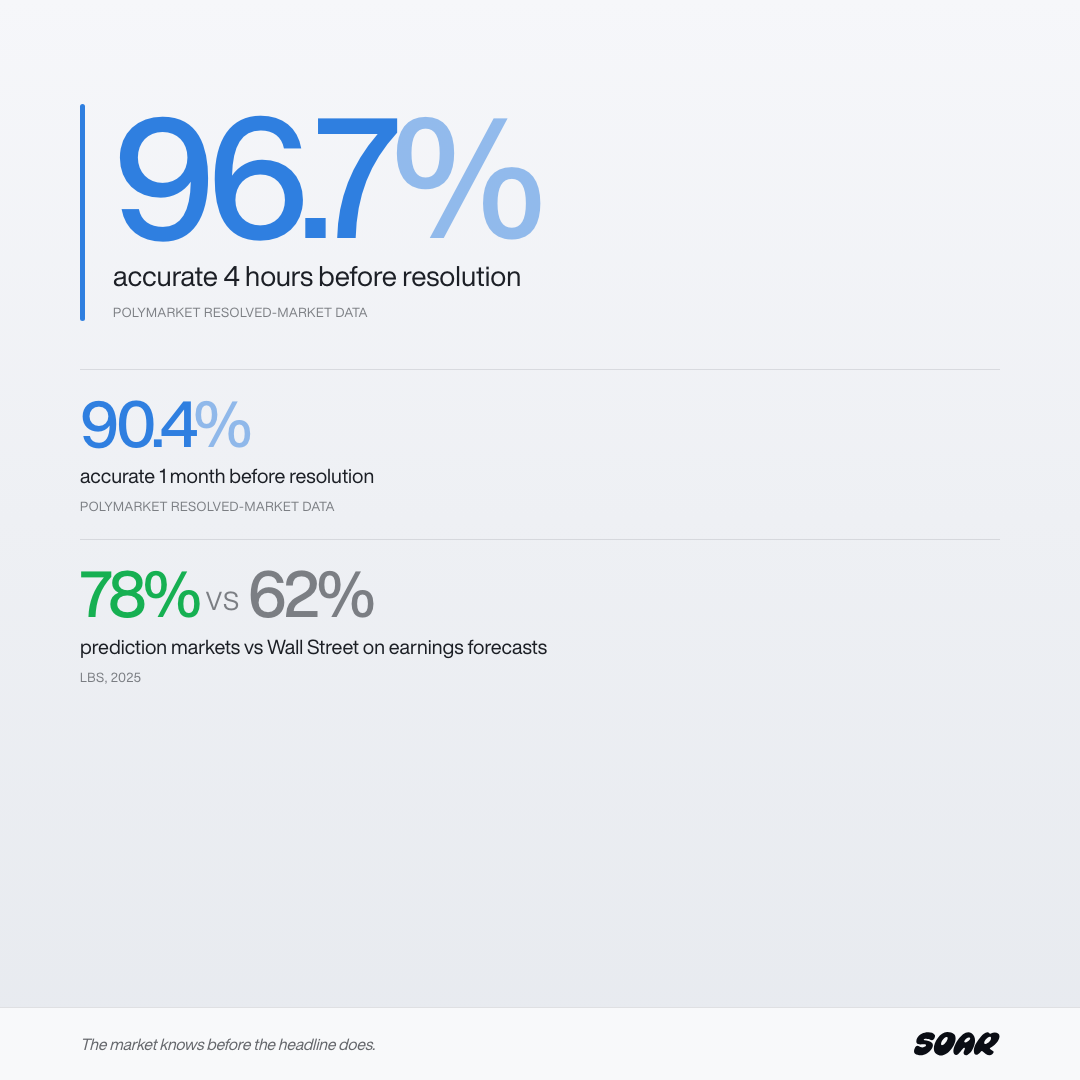
More accurate than most alternatives on well-traded markets. Polymarket’s resolved-market data shows the leading outcome matched final resolution 96.7% of the time four hours before close and 90.4% of the time one month before close. Accuracy degrades on low-volume markets where few traders participate.
What’s the difference between a prediction market and gambling?
Structurally different. Gambling has fixed odds set by a house that profits from losers. Prediction markets have variable, market-set odds — traders bet against each other, not a house. In the US, regulated prediction markets like Kalshi are designated contract markets under CFTC oversight, legally distinct from gambling.
What is a prediction market?
A prediction market is a financial exchange where traders buy and sell contracts tied to the probability of a specific future outcome, with the contract price functioning as a real-time probability estimate derived from collective market activity.
The structure is simple. A market is created around a binary question with a defined resolution date and resolution criteria — for example, “Will the Federal Reserve cut rates at its September 2025 meeting?” A contract on that market pays $1 if the answer resolves yes, and $0 if it resolves no. If that contract is trading at 64 cents, the market is saying there’s a 64% probability the Fed cuts. Every trade, in every direction, is an expression of someone’s probability estimate backed by real money.
This is the core insight that makes prediction markets interesting: prices are probability. Not an opinion, not a forecast, not a model output — a price set by the aggregate judgment of everyone willing to put capital behind their view. When new information arrives, prices update immediately as traders revise their positions. When a Fed official signals a rate cut in a speech, the 64-cent contract might move to 81 cents within minutes.
Is a prediction market the same as a bet? No — the economic function is closer to a futures market than a sportsbook. A bet is a bilateral agreement at fixed odds set by a bookmaker who profits from the spread. A prediction market is a multilateral exchange where odds are continuously set by supply and demand, traders take positions against each other rather than against a house, and positions can be bought and sold before resolution like any other financial instrument.
How prediction markets work
Prediction markets work by creating binary contracts on well-defined outcomes, allowing traders to buy and sell positions at market-determined prices until the outcome resolves and contracts pay out at $1 (yes) or $0 (no).
What does a market need to be well-defined? Three elements: the question itself, the resolution date, and the resolution criteria — the exact conditions under which the market resolves yes or no. Criteria must be unambiguous. “Will Anthropic raise a funding round above $1 trillion by December 31, 2026?” is a good market question. “Will Anthropic do well in 2026?” is not — it has no clear resolution condition.
Trading. Once live, traders buy yes contracts if they believe the outcome is more likely than the current price implies, and no contracts if they believe it’s less likely. A trader who thinks the Fed is 80% likely to cut rates when the market is at 64 cents has an edge — the market is underpricing the probability. They buy yes contracts at 64 cents. If the market moves to 80 cents before resolution, they can sell at a profit without waiting for the event.
Liquidity. Most prediction markets use an automated market maker (AMM) or an order book to match buyers and sellers. Platforms like Polymarket use AMMs that algorithmically provide liquidity; platforms like Kalshi use order books similar to stock exchanges. Either way, traders can enter and exit positions continuously rather than being locked in until resolution.
Resolution. On the resolution date, the market resolves based on its stated criteria. Yes contracts pay $1. No contracts pay $0. The platform uses a trusted oracle, a CFTC-designated data source, or a committee resolution process depending on the market type.
How prices are set — and what they mean
Prediction market prices are set by the collective judgment of all active traders, weighted by the capital they’re willing to commit — making them a real-time, continuously updated probability estimate derived from market consensus rather than any individual’s forecast.
This is the wisdom of crowds mechanism. No single trader controls the price. When a trader believes a contract is mispriced — that the market is assigning 40% probability to something they think has a 70% chance of happening — they buy contracts, pushing the price up. Other traders who disagree sell contracts, pushing it back down. The price stabilises where buyers and sellers are roughly balanced, which in practice is the market’s best estimate of true probability.
The result is a price that aggregates information from everyone paying attention to that outcome — economists, political scientists, insiders, journalists, and retail traders all simultaneously moving the same market. Unlike a poll, which captures a snapshot of stated opinion, a prediction market captures revealed preference: what people are willing to bet, not just what they’re willing to say.
How does implied pricing work across multiple markets?
When a platform runs multiple binary markets on the same subject at different thresholds, the spread of prices implies a full probability distribution — not just a single yes/no. For example, five markets on the same company’s next funding round — priced at 91%, 64%, 38%, 19%, and 7% across ascending thresholds — imply a full valuation distribution.
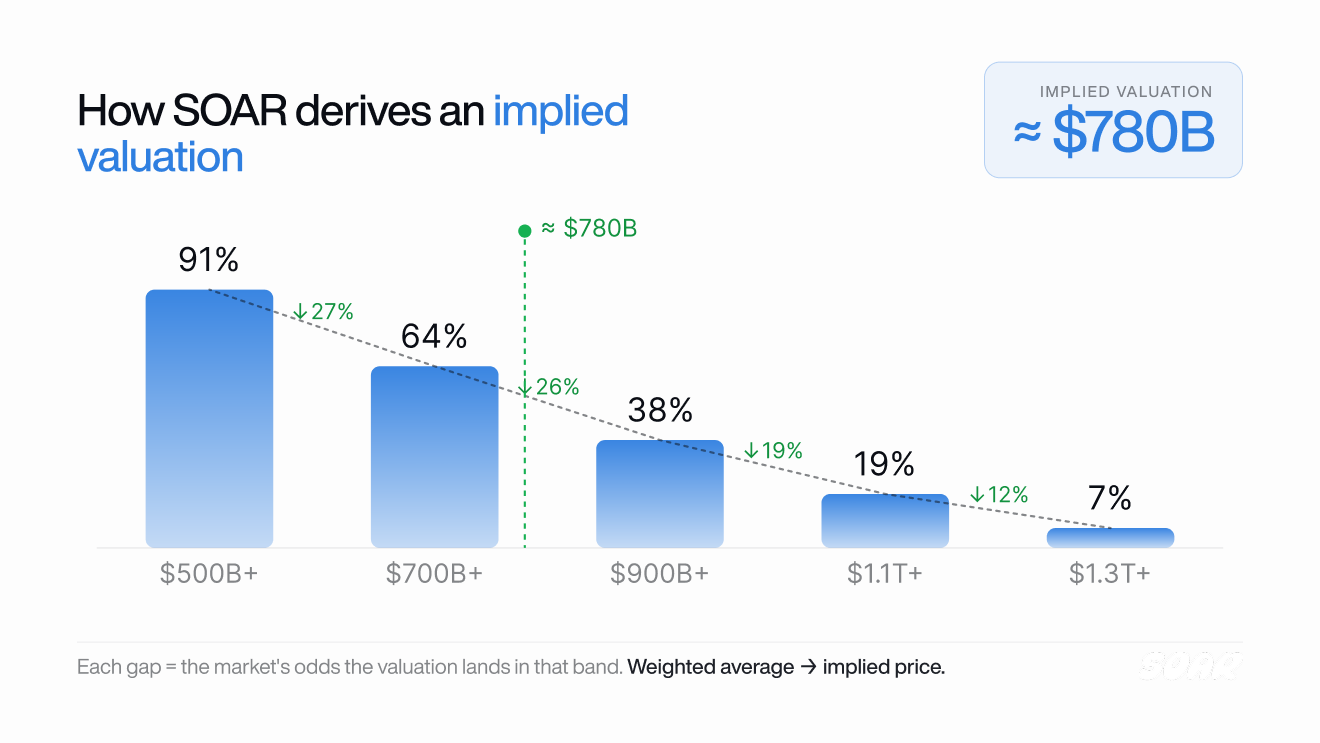
The gap between each market represents the probability the true value falls in that range. Implied pricing here is the same principle options traders use to back out an implied spot price from a full options chain.
Why do prediction market prices change over time?
Prices change when new information reaches the market and traders update their probability estimates. A Fed speech, an economic data release, a company announcement, a news report — anything that changes the expected probability of an outcome will move the price as traders adjust their positions. Well-followed markets update within seconds. Niche markets may take longer.
Are prediction markets accurate?
Prediction markets are demonstrably more accurate than polls, expert forecasts, and most quantitative models on well-traded markets, with the strongest evidence coming from political elections, economic indicator forecasting, and scientific replication studies.
The 2024 US presidential election is the most cited recent example. Polymarket’s final market showed a 67% probability of a Trump win, against most polling aggregators showing a near-toss-up. Trump won with a margin that surprised most forecasters. The prediction market’s directional call was correct when polls were not.
- A 2020 meta-analysis in Judgment and Decision Making found that prediction markets outperformed expert panels in 74% of head-to-head comparisons.
- A 2025 paper from LBS showed that prediction markets correctly forecasted 78% of earnings events, vs 62% on Wall Street.
- Polymarket’s official accuracy data shows markets are 96.7% accurate 4 hours before resolution, and 90.4% accurate 1 month out.
The caveats are real. Thin markets — those with few active traders and low volume — are easier to manipulate and less reliable as probability signals. Politically charged markets attract noise traders whose ideological commitment outweighs their probability judgment. And markets can be wrong: Polymarket gave the 2016 Brexit referendum only a 25% chance of passing — it passed. The honest summary: prediction markets are the best available real-time probability signal on well-traded questions, and significantly less reliable on low-volume or obscure ones.
Prediction markets vs gambling
Prediction markets and gambling are legally and structurally distinct: gambling involves fixed odds set by a house that profits from losers, while prediction markets involve variable odds set by traders who bet against each other, with platforms collecting a fee on volume rather than profiting from losses.
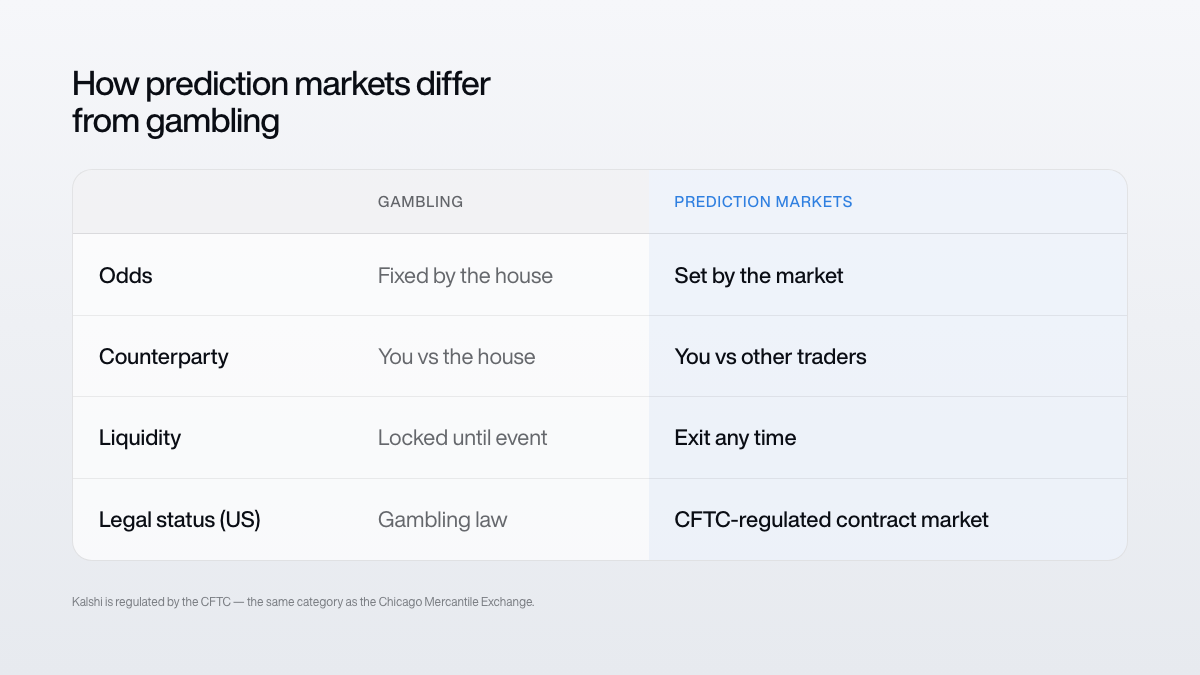
Odds. A sportsbook sets odds to ensure a margin — the total implied probability across all outcomes sums to more than 100%, and the house pockets the difference. Prediction market prices are set by market participants; the platform doesn’t set odds and doesn’t profit when traders lose.
Counterparty. In gambling, you bet against the house. In a prediction market, you trade against other market participants. Your yes contract is the counterparty to someone else’s no contract.
Liquidity. Gambling bets are typically locked in until the event resolves. Prediction market positions can be bought and sold continuously before resolution, like any financial instrument.
Regulatory status. In the US, Kalshi is regulated by the CFTC as a designated contract market — the same regulatory category as the Chicago Mercantile Exchange. The 2023 federal court ruling in Kalshi’s favour confirmed that event contracts on political outcomes are legal under the Commodity Exchange Act, not gambling under state law. Polymarket operates outside the US regulatory framework using blockchain settlement, which creates different legal considerations for US users.
The “is this gambling?” question matters because the answer determines regulatory treatment, tax treatment, and which institutional participants can legally access the market. The US regulatory framework has increasingly answered it: well-structured prediction markets are financial instruments, not gambling products.
The main platforms — Polymarket, Kalshi, and beyond
The two primary prediction market platforms operating at scale in 2026 are Polymarket (largest global volume, crypto-settled) and Kalshi (CFTC-regulated, US legal, dollar-settled) — each with different regulatory status, market coverage, and user profiles.
Polymarket
Polymarket is the largest prediction market by volume, operating on the Polygon blockchain with USDC settlement. Markets cover US and global politics, economics, crypto, sports, and science. Polymarket processed over $8 billion in volume in 2024, per company data, driven largely by election markets. Polymarket is not regulated by the CFTC and does not accept US users directly.
Kalshi
Kalshi is a CFTC-regulated designated contract market, making it the only major prediction market platform that is unambiguously legal for US retail users. Kalshi uses dollar settlement rather than crypto and covers a broader category range including economic indicators, weather, and finance. Following its 2023 court victory over the CFTC on political event contracts, Kalshi has expanded its market offerings significantly.
Is Polymarket legal in the US? Polymarket’s terms of service prohibit US users from participating. The platform is not registered with the CFTC and does not hold a licence to operate in the US. US users who access Polymarket via VPN or other means do so in a legal grey area — the platform itself has blocked US IP addresses. For US users seeking a regulated prediction market, Kalshi is currently the clearest legal option.
What prediction markets don’t cover yet — and what SOAR is doing about it
No major prediction market platform currently offers markets on private companies — the category that arguably needs price discovery the most. Polymarket, Kalshi, and their competitors cover events with a public underlying: election outcomes that resolve on a known date, economic indicators published by government agencies, sports results with official scorekeepers. None of them have built markets for private companies, where there’s no public price, no exchange, no quarterly earnings release, and no official valuation until the company chooses to raise.
That gap is significant. The most followed companies in 2026 — Anthropic, SpaceX, Stripe, OpenAI — are all private. Their valuations move, their funding rounds happen, their IPO timelines shift — and none of it is tradable on any existing prediction market. Investors, analysts, and informed observers have views on these outcomes. There has been no market for those views.
SOAR is the first startup trading platform to build prediction markets specifically for private tech companies. Where Polymarket runs a market on whether the Fed will cut rates, SOAR runs markets on whether Anthropic’s next round will price above $1 trillion, whether SpaceX will IPO before 2027, and whether Stripe’s next valuation will exceed $200 billion. Each market has continuous pricing driven by collective trader conviction, updated in real time as new information — funding announcements, hiring data, product launches — reaches the market.
Because SOAR runs multiple markets on the same company at different valuation thresholds, the spread of prices across those markets implies a complete valuation distribution — a real-time, market-derived estimate of what informed traders think a private company is actually worth. No investment bank. No 409A appraisal. Just the market.
For anyone who wants to take a position on the private companies defining the next decade — without accreditation requirements, without lock-ups, without Right of First Refusal clauses blocking their transaction — prediction markets via SOAR are the only route that currently exists.
Frequently asked questions
What is a prediction market in simple terms?
A prediction market is an exchange where traders buy and sell contracts on whether a specific future event will happen. The price of a contract reflects the market’s collective estimate of the probability — a contract at 70 cents implies a 70% chance of that outcome occurring. Contracts pay $1 if the outcome happens and $0 if it doesn’t.
How do prediction markets make money?
Prediction market platforms charge a percentage of trading volume or a fee on winnings rather than setting odds that favour the house. Kalshi charges a fee on profits. Polymarket charges a percentage of the traded amount. Neither platform profits when traders lose — revenue comes from activity, not from outcomes. This is structurally different from a sportsbook, which profits from the spread between implied probabilities and true odds.
Are prediction markets legal in the US?
Regulated prediction markets are legal. Kalshi is a CFTC-designated contract market and is fully legal for US retail users. Polymarket is not registered with the CFTC and does not accept US users per its terms of service. SOAR operates under applicable regulatory frameworks and does not require users to be accredited investors.
What’s the difference between Polymarket and Kalshi?
Polymarket is the larger platform by volume, crypto-settled, global in reach, and not available to US users under its terms of service. Kalshi is CFTC-regulated, dollar-settled, legally available to US retail users, and covers a broader range of market categories including economic indicators. Both are real-money prediction markets; Kalshi has higher regulatory clarity for US participants.
Can I trade on prediction markets without being an accredited investor?
Yes. Prediction markets, including Kalshi and SOAR, do not require accredited investor status. This distinguishes them from most private market investing routes — secondary markets, angel networks, and VC funds all require accreditation. Prediction markets are open to any eligible adult in supported jurisdictions.
What happens if a prediction market resolves incorrectly?
Reputable platforms publish resolution criteria upfront and have dispute processes for contested outcomes. Kalshi uses CFTC-registered data sources and has a formal appeals process. Polymarket uses a decentralised UMA oracle with a dispute resolution mechanism. SOAR publishes resolution methodology per market. The most common issue is ambiguous resolution criteria — which is why well-designed markets define outcomes with precision before trading opens.
Start trading on SOAR
SOAR is the only platform where you can take a position on Anthropic, SpaceX, Stripe, and OpenAI — with no accreditation, no minimum, and no lock-up. Explore live markets at SOAR.
Trading event contracts involves risk and may not be suitable for everyone. You could lose the funds used to enter any transaction.