

The fucked up part is that it’s obvious now. OpenAI’s most recent funding round ($122 billion in March) is 40x the IPO market cap of Microsoft, Apple, and Amazon combined. Unfortunately your retirement account is stuck buying more Cisco which hasn’t hit an all-time high in 25 years instead of Stripe, Anthropic, etc.
We were sold the idea that public markets were a place of opportunity; where we could get a piece of the best America had to offer. The companies who’d take the world by storm.
This is no longer true.
For decades, anyone could compound wealth through the public markets. Nvidia ($NVDA), Tesla ($TSLA), and Netflix ($NFLX) all went public early enough for ordinary investors to capture extraordinary upside (roughly 9,000x, 375x, and 800x since IPO, respectively).
Then… something broke.
Companies realized that going public was costly, risky, and burdensome, while private market funds continued to expand and the appetite of investors ballooned. The money that only public markets could offer became available without the paperwork, disclosures and the weight of shareholders. Private capital markets got so deep that the best companies raise billions for ten or fifteen years without the public getting a sniff. In other words, your money isn't good enough.
This shift has been building since the 1979 Department of Labor clarification of ERISA's prudent man rule enabled pension funds to invest in venture capital. Over the past 25 years, US public-market capitalization grew fourfold, while private-market AUM grew 35x. There are 6x more private unicorns than public companies with a $1B+ market cap, and seed checks have gone from ~$500K in 2010 to an average of $3M in 2025.
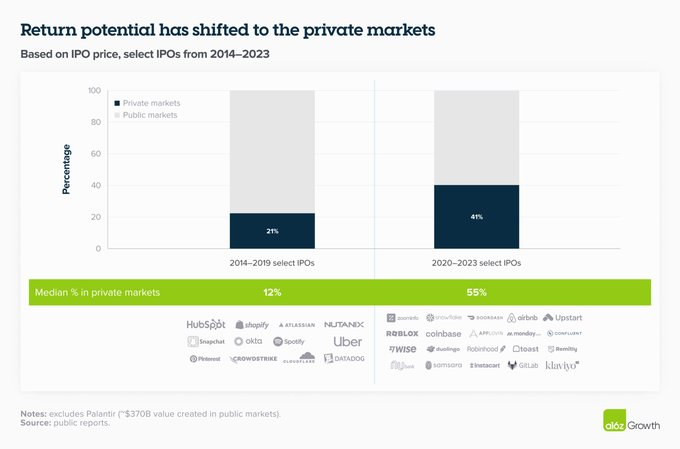
Opportunities are arguably more abundant today than ever before. Unfortunately, most don’t have a seat at the table.
The trickle-down IPO
On May 4th, Cerebras ($CBRS) filed its S-1 for IPO (yay, finally an exciting IPO) with a price range of $115–$125 a share. On May 13th, institutional clients (and a sliver of retail) were allocated at $185. The stock opened at $350. Buyers at the open paid 89% more than the institutional clients who got allocations the night before, 192% more than the company itself had marketed the deal at three weeks earlier, and ~700 times more than the venture capitalists who funded the company a decade ago - only for open-market buyers to be down 10% day 1.
Look at Snowflake ($SNOW). Worth $5 million at its Series A in 2012, $12.4 billion by its final private round in early 2020, and IPO’d at 33B. If you bought at IPO, you'd be down nearly 50%. Many such cases. Figma ($FIG), another massive IPO, is down ~30% from IPO price. Even when companies FINALLY go public, many times it’s -EV for everyone but insiders.
This is what public markets have come to look like. Private markets squeeze most of the value, institutions take their middleman rake, and open-market buyers PVP for the scraps.
The free-agent economy
Every public-market incumbent’s market cap is at risk. Big labs (OpenAI, Anthropic, etc.) seem to release features consistently that chunk public valuations. As AI disrupts longstanding businesses and companies, do the winners that emerge continually exist as earlier-stage private companies? It’s not hard to envision a universe where capital markets and entire sectors essentially become free agents with the de-facto leaders succumbing to smaller, technically inclined teams. Similar to Citrini’s thoughts on how AI can affect markets and the world we know, what if the primary disruption stems from public companies being superseded en masse via startups that only a select few have access to? Salesforce, ServiceNow, and Chegg may be just the tip of the iceberg for what we see over the coming years.
Public markets were not built for an age where companies could hit billions in value overnight. In a world where companies raise more, scale faster, and private valuations swell, it is equitable and necessary that we expand earlier opportunities or fix the mechanisms that are preventing them from becoming public companies.
Public, except where it matters most
The push towards making private markets and venture more "familiar" is hardly a secret. Many funds now have dedicated PR and media teams while private companies look and feel like public companies, albeit without the ticker. I can go on about the hype videos, the fundraising announcements highlighting valuations, and the frequent financial disclosures (ARR, MRR, etc.). In some ways it's a cruel ritual where we see the huge numbers and contribute to them through usage, yet are sidelined while their Series X round gets marked up once again.
Ironically enough, one of the only opportunities for entries to these companies (secondaries) was halted last week by Anthropic and OpenAI seemingly after some ill-timed broker deals were being negotiated via X.
These secondary markets have traded billions of dollars but can seemingly be turned off at a whim (Can’t wait to read the lawsuits). Guess we will just have to buy at a trillion-dollar valuation and smile.
A new public market
The next frontier will not be public markets or even markets that exist today. Hiive, EquityZen, and even crypto have started finding ways to bring great ideas and opportunities to buyers/speculators/investors quicker and faster than traditional venues have offered. The persisting issue has and will continue to be that secondaries and early-stage investments carry many risks outside of the company itself such as dilution, rights, paperwork, and transferability. For late-stage private companies these issues usually sort themselves, but what about the other 99%?
I believe we’re in the midst of a capital markets revolution. The outcome? Synthetics or derivatives will be the best way to speculate on early-stage companies, alongside certain tokenization opportunities.
Futures and synthetics work best for markets where spot exposure contains specific hurdles. Futures for commodities such as oil typically do 10-20x the volume of their spot counterpart because who wants to take possession of barrels of oil when you can just trade the price?Similarly, why deal with cap tables and access when you can simply trade the value. Getting exposure to the best companies of the future will necessitate new forms of markets and capital formation, long before they become available on Robinhood.
Markets can't keep up
America has thrived because there is no better place to raise capital for and build a company. Trillions in value have been created by those willing to take the risky bets.
The issue is not that America stopped creating great companies. It is the opposite. America is creating companies so valuable, so quickly, that the market structure built to share that upside cannot keep up and incentives to do so are materially broken.
IPOs used to be a means to accelerate companies; letting the common man grow alongside the business. I fear this opportunity is eroding. My question lies at the root of this discussion. Are consumer protection laws actually protecting anyone? Are most Americans too dumb to invest in early-stage companies? Only sophisticated enough to gamble their winnings away on sports betting and lottery tickets?
Companies are scaling quicker than ever while time to IPO has doubled in recent years. The companies defining the next years and decades will be household names long before Robinhood can list them. There needs to be a market for companies before IPO. Synthetics, derivatives, tokenization, secondaries, new forms of capital formation. The mechanism can evolve, but the need is already here.
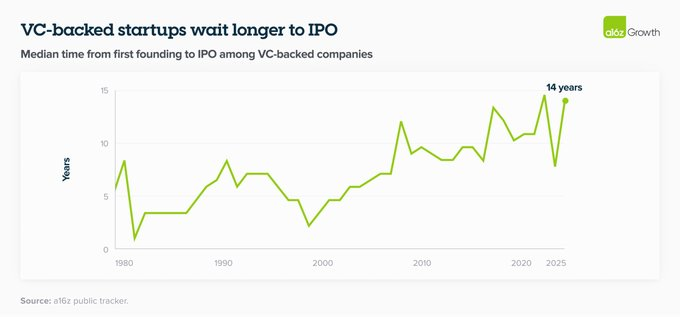
The American dream cannot persist if public markets serve only as VC and insider exit liquidity, while most citizens are locked out of where wealth is created.We must build new markets.